








Introduction
Compass Rose A compass rose is more than a decorative shape on a map. For centuries, it has helped sailors, travelers, students, and map readers understand direction. It points toward north, south, east, and west, but its meaning goes far beyond simple navigation.
The compass rose has become a symbol of guidance, discovery, protection, movement, and personal direction. You can find it on old sea charts, modern maps, tattoos, logos, artwork, and even home décor. Its design may look simple at first, but every point, line, color, and shape carries a deeper story.
This article explores the history, symbolism, and hidden meanings behind the compass rose, while also explaining why this classic navigation symbol still feels important today.
BIO
| Label | Information |
|---|---|
| Name | Compass Rose |
| Type | Navigation Symbol |
| Main Purpose | Show directions on maps |
| Origin | Ancient maritime navigation |
| Primary Directions | North, South, East, West |
| Extended Points | 8, 16, or 32 directions |
| Common Use | Maps and nautical charts |
| Key Symbolism | Guidance and direction |
| Associated Themes | Travel and exploration |
| Popular in Tattoos | Yes, widely used |
| Modern Applications | Maps, logos, décor |
| Notable Meaning | Balance and life direction |
| Relevance Today | Navigation and symbolism |
What Is a Compass Rose?
A compass rose is a figure used on maps, nautical charts, and compasses to show directions. It usually displays the four main directions: north, south, east, and west. Many versions also include northeast, southeast, southwest, and northwest.
On detailed nautical charts, a compass rose can have 16 or even 32 points. These extra points help navigators understand more precise directions. For sailors, this was especially important because even a small change in direction could affect a journey across open water.
The compass rose is not the same as a physical compass. A compass is a tool with a magnetic needle. A compass rose is the directional symbol printed or drawn on a map. Together, they help people understand where they are and where they need to go.
A Brief History
The history of the compass rose is closely connected with sea travel. Long before modern GPS, sailors relied on the stars, wind, coastlines, and compass directions to move safely from one place to another.
Early maritime charts often used wind roses. These designs showed wind directions used by sailors in the Mediterranean and other trading routes. Over time, these wind-based symbols developed into the compass rose we recognize today.
During the medieval period, portolan charts became important for navigation. These charts often showed networks of lines spreading across the map. They helped sailors follow coastal routes and understand direction with more confidence.
By the Age of Exploration, the compass rose became a familiar feature on maps. It was practical, but it was also artistic. Many mapmakers decorated it with bold colors, elegant points, and symbolic details. It was both a tool and a mark of craftsmanship.
The Four Main Directions
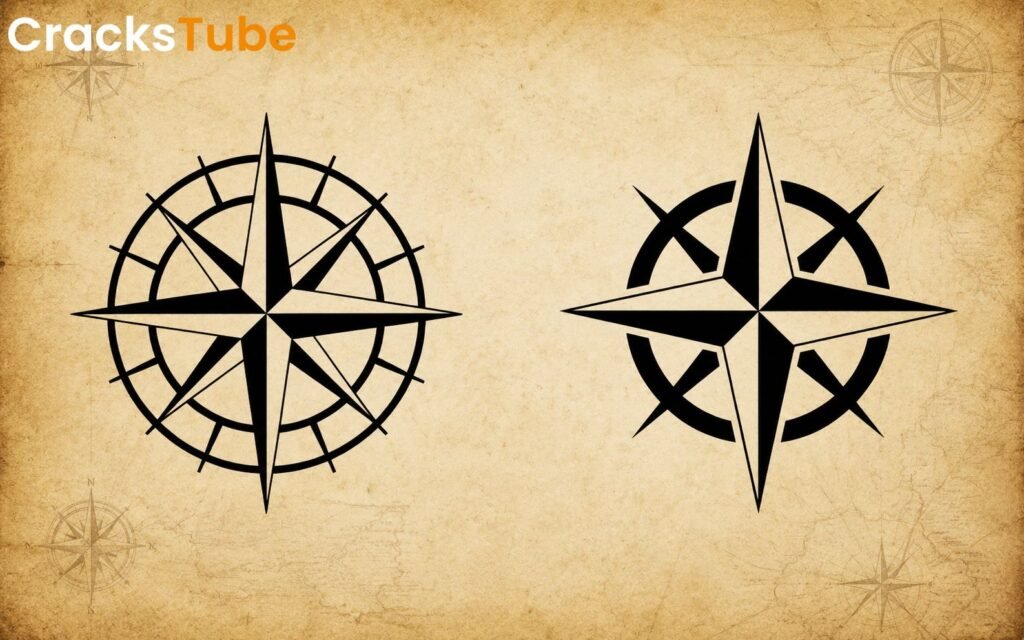
The most basic compass rose includes four main points: north, south, east, and west. These are known as the cardinal directions.
North is usually the most emphasized point. On many maps, it is marked with a larger arrow, a letter “N,” or a decorative symbol. This is because north has long been used as the main reference direction in map reading.
South sits opposite north and helps create balance in the design. East is traditionally linked with sunrise, beginnings, and movement. West is often connected with sunset, endings, journeys, and distant horizons.
Together, these four directions give the compass rose its foundation. They make it useful, clear, and easy to read.
The Meaning of North
North is often the most powerful part of a compass rose. It is usually drawn larger than the other points because it acts as the main guide. Once a person knows where north is, the other directions become easier to understand.
Symbolically, north often represents truth, clarity, purpose, and leadership. It suggests a steady path and a clear goal. This is one reason why many people use compass rose designs in tattoos and logos. The symbol can represent staying focused even when life feels uncertain.
In older maps, north was not always placed at the top. Some maps were arranged differently depending on culture, religion, or purpose. Over time, however, north-up maps became more common, especially in modern cartography.
Intercardinal Points
A more detailed compass rose includes the intercardinal directions: northeast, southeast, southwest, and northwest. These points sit between the four main directions.
These directions make navigation more accurate. Instead of only moving north or east, a traveler can move northeast. This gives a clearer sense of route and position.
Symbolically, these in-between points can represent choice, flexibility, and transition. Life is rarely a straight path. The intercardinal points remind us that direction can be more detailed than simply going one way or another.
The 16 and 32 Point Compass Rose
Some compass roses are much more detailed. A 16-point compass rose adds secondary directions such as north-northeast and east-southeast. A 32-point compass rose goes even further.
Historically, sailors used these points to describe winds and sailing directions with greater accuracy. This was especially useful before electronic navigation. A 32-point compass rose gave sailors a more refined way to talk about movement, bearing, and course.
Today, these detailed designs are often used for style, education, and historical reference. They still carry a strong sense of adventure because they remind us of old voyages, sea routes, and exploration.
Hidden Meaning of Guidance
One of the most important meanings of the compass rose is guidance. Its main purpose is to show direction, but emotionally, it can also represent finding your way in life.
People often connect the compass rose with personal journeys. It can symbolize making decisions, choosing a path, or staying true to one’s values. This is why it appears in tattoos, jewelry, travel branding, and motivational artwork.
The compass rose does not promise that every path will be easy. Instead, it suggests that direction matters. Even when the route is difficult, having a sense of where you are going can bring confidence.
Symbol of Protection
For sailors, direction was not just useful. It was a matter of survival. A wrong route could lead to storms, dangerous rocks, or getting lost at sea.
Because of this, the compass rose became connected with protection and safe travel. It helped guide ships through uncertain waters and gave sailors a sense of security.
This protective meaning still exists today. Many people see the compass rose as a symbol that watches over travelers. It can represent a wish for safe journeys, whether across oceans, roads, or personal challenges.
Spirit of Adventure
The compass rose is also strongly linked with adventure. It appears on maps, and maps naturally make people think of new places, hidden routes, and unknown lands.
During the great periods of exploration, maps were tools of discovery. The compass rose helped explorers move beyond familiar places. It became part of the visual language of travel, courage, and curiosity.
Today, the symbol still speaks to people who love travel. It can represent the desire to explore the world, take risks, and experience life beyond one’s comfort zone.
Balance and Stability
The design of a compass rose is usually balanced. Its points spread evenly in different directions. This gives it a calm and stable appearance.
Because of this, the compass rose can symbolize balance, harmony, and inner stability. It shows that every direction has a place. North needs south. East needs west. The whole design works because the points are connected.
In a personal sense, this can represent balance in life. It may remind someone to stay grounded while still moving forward.
Colors and Their Meanings
Compass rose designs often use simple colors, but those colors can carry meaning.
Black and white designs are common in traditional maps. They look clean, serious, and timeless. They also make the direction points easy to read.
Red is often used to highlight north or another important point. Red catches attention quickly, which makes it practical for navigation. Symbolically, it can suggest energy, importance, and warning.
Gold compass rose designs often feel more decorative. Gold can represent value, wisdom, success, or heritage. This is why gold compass roses are popular in artwork, logos, and luxury-style designs.
Blue is often connected with the sea, sky, and travel. It gives the compass rose a calm and maritime feeling.
Compass Rose in Culture
The compass rose has appeared in many cultures because direction is important everywhere. Different societies have used direction symbols for travel, religion, architecture, and storytelling.
In European maritime tradition, the compass rose became closely tied to sailors and sea charts. It helped guide trade, exploration, and naval travel.
In many cultures, directions also carry spiritual or symbolic meaning. East may be linked with sunrise and renewal. West may suggest endings or reflection. North can represent strength or wisdom, while south may be connected with warmth and openness.
Although meanings vary, the compass rose is now understood globally. It has become a universal symbol of movement and orientation.
Compass Rose in Tattoos
Compass rose tattoos are very popular because the design is meaningful and visually strong. People often choose this symbol to represent life direction, travel, freedom, and personal growth.
For some, it means they are trying to find their path. For others, it represents a love of adventure. It can also honor a person who gave guidance, such as a parent, mentor, or loved one.
A compass rose tattoo can also mean staying grounded. Even when life changes, the symbol reminds the person to keep moving with purpose.
Compass Rose in Modern Design
The compass rose is still used in modern maps, atlases, nautical charts, and educational materials. Even with GPS and digital navigation, the symbol remains useful because it teaches people how direction works.
It is also common in branding. Companies that want to express trust, movement, travel, leadership, or discovery often use compass-inspired designs. A compass rose can make a brand feel reliable and purposeful.
In home décor, the compass rose adds a classic travel feeling. It is often used in wall art, floor designs, clocks, and nautical-themed spaces.
How to Read It
Reading a compass rose is simple once you understand the basic directions. Start by finding north. It is usually marked with an “N” or a larger arrow.
Once you know north, you can identify south directly opposite it. East is usually on the right side, and west is on the left side when north is at the top.
More detailed compass roses include smaller points between these directions. These help show more exact movement. On some maps, you may also see degrees around the compass rose. North is usually 0 or 360 degrees, east is 90 degrees, south is 180 degrees, and west is 270 degrees.
Common Myths
One common myth is that a compass rose and a compass are the same thing. They are related, but they are not the same. The compass is the instrument. The compass rose is the directional design.
Another myth is that the compass rose is only used by sailors. While it has deep maritime history, it is also used in geography, education, design, travel, and symbolism.
Some people also think the compass rose is only decorative today. In reality, it still has practical value. It helps people understand maps and directions, especially in learning environments.
Why It Still Matters
The compass rose still matters because direction still matters. Technology has changed how we travel, but people still need to understand location, orientation, and movement.
For students, the compass rose is one of the first tools used to learn map reading. For travelers, it remains a familiar sign of direction. For artists and designers, it offers a timeless shape full of meaning.
Its deeper value is emotional. The compass rose reminds people that life is a journey. It speaks to anyone who is searching, moving, learning, or trying to find the right path.
Conclusion
The compass rose is one of the most meaningful symbols in map history. It began as a practical tool for navigation, but over time it became a powerful image of guidance, safety, adventure, and purpose.
Its points show direction, but its meaning reaches much deeper. It represents the human desire to explore, stay balanced, and move through life with confidence.
Whether you see it on an old sea chart, a modern map, a tattoo, or a piece of artwork, the compass rose still carries the same message: know your direction, trust your journey, and keep moving forward.
Itzhak Ezratti Wife: Interesting Facts You May Not Know
FAQs
What does a compass rose symbolize?
A compass rose symbolizes guidance, direction, exploration, and finding the right path. It is often associated with travel, personal growth, and navigation.
Why is north highlighted on a compass rose?
North is usually emphasized because it serves as the primary reference point for navigation. Most maps are oriented with north at the top.
How many points can a compass rose have?
A compass rose can have 4, 8, 16, or 32 points. More points provide greater directional accuracy, especially for navigation at sea.
Is a compass rose still used today?
Yes. Although GPS is widely used, the compass rose remains important in maps, education, navigation, design, and branding.
Why do people choose compass rose tattoos?
Many people choose compass rose tattoos to represent guidance, freedom, adventure, protection, and staying true to their life journey.